AI operations for private equity, platforms, and acquirers.
The AI mandate is in the plan. The execution isn't in the portco. We fix that.
Your portfolio companies were told to adopt AI. Most have a few tools, no owner, and a CFO who doesn't know where to start. We put the operating layer into one company at a time: a fixed-price Diagnostic, the fix engineered into the software they already run, EBITDA you can show in diligence. Built by operators who built and sold their own company.
One accountable team. Every company in the portfolio. Measured the same way.
AI-native engineering, shipped to production
The brand, the marketing and the system that sells it
Leads, follow-up and renewals handled, with a person approving what matters
Numbers you can see every month
The work your team repeats, done by the system
Proof the work got done, not a promise




On the job. On the phone. Both at once.
Industry figures put 15 to 25 percent of calls to service businesses as missed or mishandled, and fewer than half of inbound leads booked.
Source: ServiceTitan, 2026


Why it stalls
Sponsors mandated it. Portfolio companies can't execute it.
Every operating partner we talk to has the same slide: AI is in the value-creation plan for every company in the fund. And the same problem under it: the portco has a few tools, nobody who owns them, and a CFO who was handed the mandate without a team. The gap isn't strategy. It's installation.
What stalls
The mandate without a mechanic.
The plan says AI. The portco has twelve people in the office and none of them builds software. So the mandate becomes a vendor demo, then a pilot, then a line item nobody mentions.
A mandate without an installer is a slide.
What stalls
Three companies, three tool piles.
Each portco bought what its old owner liked. Nothing connects, nothing is measured the same way, and the board hears three different stories about the same problem.
You can't roll up what you can't compare.
What stalls
The CFO as integrator.
Finance inherits the AI project because nobody else will take it: the vendor calls, the data pulls, the "why doesn't this sync." It was never theirs to own.
Operating rule 001: the CFO is not the systems integrator.
The mandate gap· what the surveys say
Operating-partner surveys, 2026 · vendor-produced, read accordingly.
Sponsors
98%
have mandated AI adoption across their portfolio companies.
Accordion, PE AI Adoption Benchmark, 150 operating partners, May 2026
Portfolio companies
~50%
are actively implementing it. The other half have the mandate and not much else.
Accordion, 2026
PE-backed CFOs
68%
don't know where to start. 63% of portcos have no formal AI structure at all.
Accordion, 2026
At scale
7%
of portcos run AI at enterprise scale; 36% use it at all. Talent is the top constraint.
FTI Consulting, 2026 PE AI Radar, 200 fund and operating leaders, May 2026
The gap isn't strategy.It's nobody inside a $5M to $50M company who can install the thing.
That's the job we do.One company at a time, at a fixed price.
A portfolio doesn't need an AI strategy. It needs the layer installed, one company at a time.
An operating layer connects the software each company already runs, sets one way the work moves, puts a named owner on every exception, and reports the same numbers in every company. We install it at a fixed price per company, then keep building. The deal team goes back to deals.
What we actually do
We make your phones, your software, and your people work like one business.
Most shops don't need more software. They have plenty: the phone system, the texting app, the field service software, the invoicing. What fails is everything between them: the handoffs, the follow-up, the owner stuck in the middle. That's engineering work, and it's the work we do. Not an answering service. Not a software demo. We build the layer that runs the work.
01
Answer every call
Every call, every hour, answered and logged. After hours and weekends included. The caller gets a real answer and a booked slot, not a voicemail.
02
Chase every estimate
Every estimate followed up by text, call, and email, in order, until it's a yes or a no. Nobody has to remember.
03
Book and confirm
The right tech, the right slot, confirmed without phone tag. Reschedules and cancellations handled the same way.
04
Keep the customer posted
On the way, running late, job done, invoice sent. The customer hears from you before they have to ask. Anything the system can't resolve reaches a named human.
05
Show you the numbers
Calls, bookings, close rate, cash, in one place every Friday. Fixed when it drifts, and the next piece built when you're ready.
Not an answering service. Not a software demo. Engineers, building the way your business runs.
An answering service picks up the phone and sends you a message. A software vendor sells you another login. We're the team that built and sold its own software, and we build the operating layer your business runs on, inside the tools you already pay for. Then we keep building.
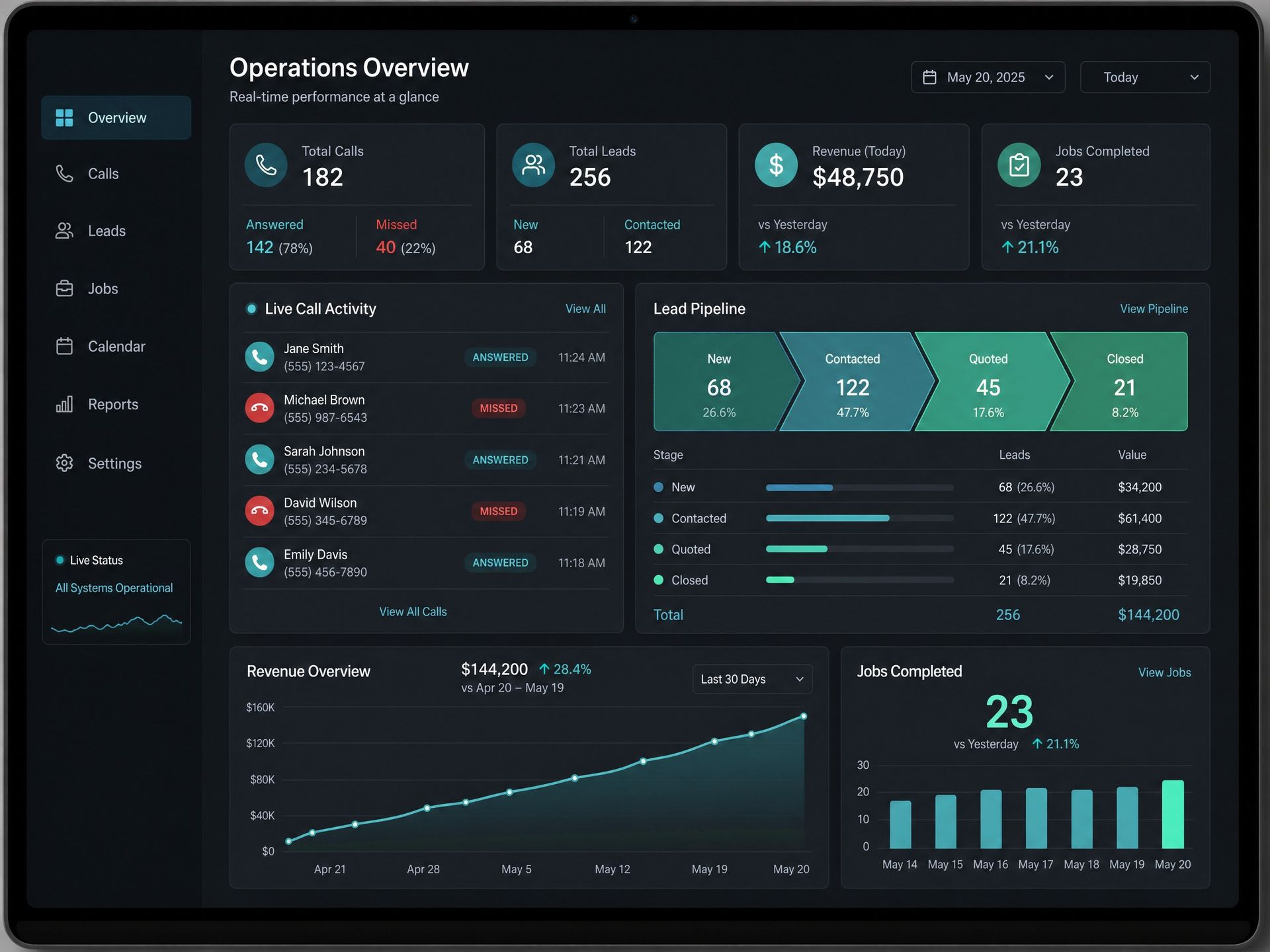
Every truck on the board. Every call on the record.
AI operations · Jacksonville and Northeast Florida · GroundedOps
First outcome
The first 100 days, with a number at the end.
Every 100-day plan has an AI line. Ours ends with a read the board can use: what the company does per call, per estimate, per job, measured the same way as the last company you bought.
01
Days 1 to 14 · The Diagnostic
Systems, owners, risks, and the one workflow worth fixing first. The Rescue scope and price in writing before anyone spends a second dollar.
02
By day 45 · Front office live
Calls answered, follow-up running, scheduling and handoffs inside the software the company already has. The first workflow, not a pilot.
03
By day 60 · Exceptions owned
A named person for everything the system can't resolve. A record of every action. The part diligence asks about.
04
Day 100 · The EBITDA read
Booked jobs per call, close rate, admin hours per job, revenue recovered from missed contacts. One number set. Then the next company.
The day-100 read
Five numbers, measured the same way in every company.
Booked jobs per call
per company, per month
Estimate close rate
chased to a yes or a no
Admin hours per job
before and after
Revenue recovered from missed contacts
calls, forms, past customers
Exceptions without an owner
target: zero
One page. Same columns for the HVAC platform and the dental group.
Category correction
Not an AI strategy.
An operating layer with a P&L line.
The deck doesn't own the number. The vendor doesn't either. A named person inside the company does, and we're accountable to them.
The three deal moments
We work the three moments a business changes hands.
Most sponsors meet the operations problem three times: in diligence, in the 100-day plan, and in the sale. Usually with three vendors and three sets of numbers. We're one team across all three.
Before you buy
Ops Diligence
Two weeks on the target's operations: what runs on systems, what runs on the owner, and what the first 100 days would cost to fix. A number for the model, not a feeling from the site visit.
Pre-close
Fixed price
The Diagnostic, run on a target
After you close
First 100 Days
The operating layer installed inside the 100-day plan: Diagnostic by day 14, front office live by day 45, exceptions owned by day 60, the EBITDA read at day 100. Then the next company.
Post-close
Fixed price per company
Portfolio rate after the first
Before you sell
Exit Incubation™
For a portco two to seven years from exit, or an owner you're courting: the system goes in while they still own it, so the EBITDA is up and the key-person risk is down before a buyer opens the books.
Pre-exit
Also through CPAs, brokers, and exit planners
What diligence finds is what the 100-day plan fixes, and what the exit shows.
Exit Incubation is also offered through CPAs, wealth managers, business brokers, and exit planners. Advisor with a client two to seven years from a sale? Same form. Say so in the note.
Garage doors
Restoration and remediation
General contractors and remodelers
Painting, flooring, and specialty trades
Moving, hauling, and trucking
Physician- and clinician-owned partnerships
Who this is for
Lower-middle-market sponsors and the companies they buy.

The company you bought, at one table, with one map.
How we work with a fund
Start with one company. The portfolio rate goes in writing after the first Diagnostic.
—
Software subscriptions stay in the portco's name. So does the data.
—
One report format across every company, for the operating partner and the board.
—
Based in Jacksonville Beach. Southeast portcos get us on site; everyone else gets a named team and one site visit per Diagnostic.
Built for the operating partners and deal teams at lower-middle-market sponsors, and for the companies they own: $5M to $50M service businesses with plenty of software, nobody who owns it, and a 100-day plan that says AI.
Sponsors and buyers
Private equity operating partners
Deal teams and value-creation leads
Independent sponsors
Search funds and ETA buyers
Family offices
Platform CEOs and integration leads
Lenders and brokers running diligence
Portfolio companies and targets
Home services and the trades
Healthcare and dental practices and groups
Other multi-location service businesses
$5M to $50M in revenue
Owner-run, just bought or two to seven years from exit
Call us when
—
The 100-day plan says "AI" and nobody in the portco owns it.
—
The portco CFO was handed the mandate and is stalled.
—
Three companies, three tool piles, and no number that compares.
—
Diligence asked what the target actually runs on, and the answer was a shrug.
—
The exit is 24 months out and the EBITDA isn't there yet.
Not a fit
Funds that want a portfolio-wide platform before a single-company proof. Software-only diligence with no operating follow-through. Companies too small for a fixed-price Diagnostic to pay back.
How you buy it
One company first. Then the rest of the portfolio.
One accountable path, priced per company. Two weeks to learn what the portco can actually run, a fixed price to fix it, a monthly number after that, and the same playbook on the next company. The CFO isn't the integrator at any step. Neither is the operating partner.
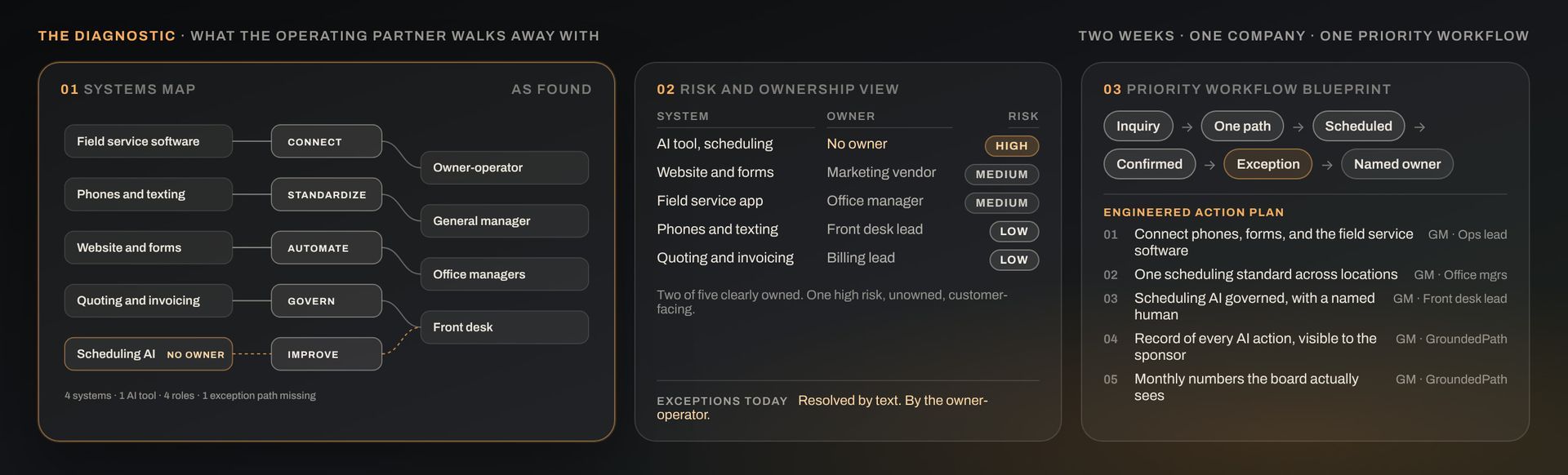
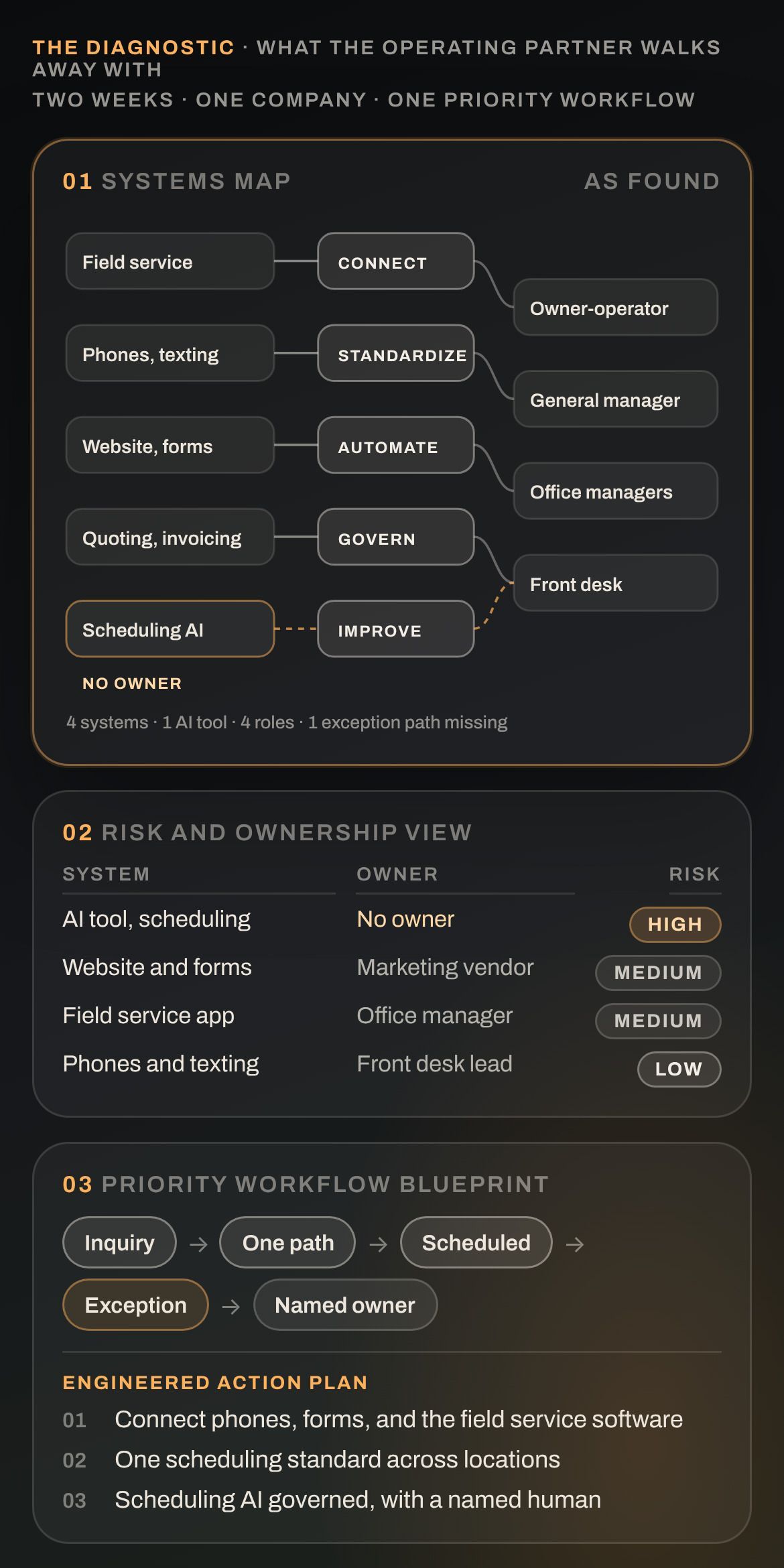
Diagnose The Diagnostic · $9,500 per company
Two weeks inside one portco. The systems, the people, the risks, and the one workflow worth fixing first. Up to five systems or AI tools, four interviews, one priority workflow. The Rescue scope and price in writing. Run it on a target before close and it's your Ops Diligence.
- Systems map, as found
- Risk and ownership view, key-person risk included
- Priority workflow blueprint, with the Rescue scope and price
Rescue Priced from the Diagnostic · fixed
The fix, engineered into the software the company already runs. The integrations, one way the work moves, handoffs that happen on their own. Permissions, escalation rules, and a named owner for every exception. The team trained in the work itself.
- The priority workflow live, inside the portco's own systems
- A named owner for every exception, a record of every action
- Software subscriptions and data stay in the portco's name
Operate Monthly · three-month minimum
We stay. The five numbers reviewed with the portco CEO and the operating partner every month, drift fixed, and the next workflow built as the company grows or adds locations. The report looks the same in every company you own.
- One review a month with the CEO and the operating partner
- One measured improvement a month
- The next workflow, when you're ready
Repeat Portfolio rate · in writing after the first Diagnostic
The second company is faster than the first: reusable components, the same report format, the same named team. Three or more companies get a portfolio rate. The deal team goes back to deals.
- Portfolio rate for three or more companies
- The same five numbers in every company
- One accountable team across the portfolio
Start
◉ Live in 60 days, or we keep building
Run
◉ The next piece each quarter, at the $10,000 level
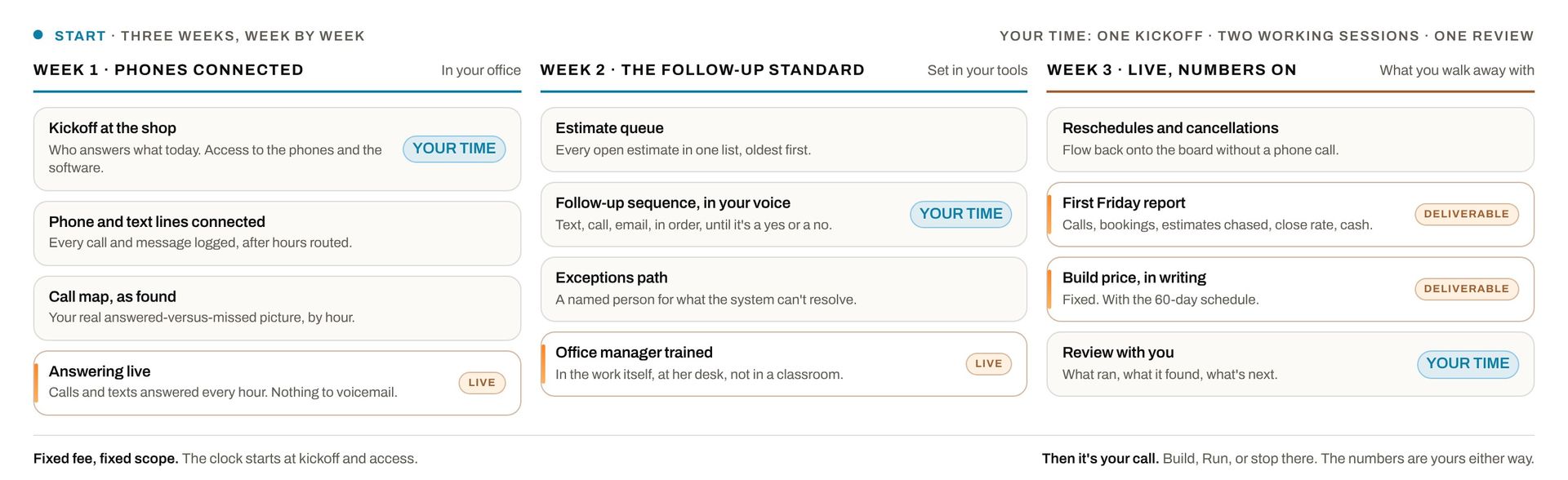
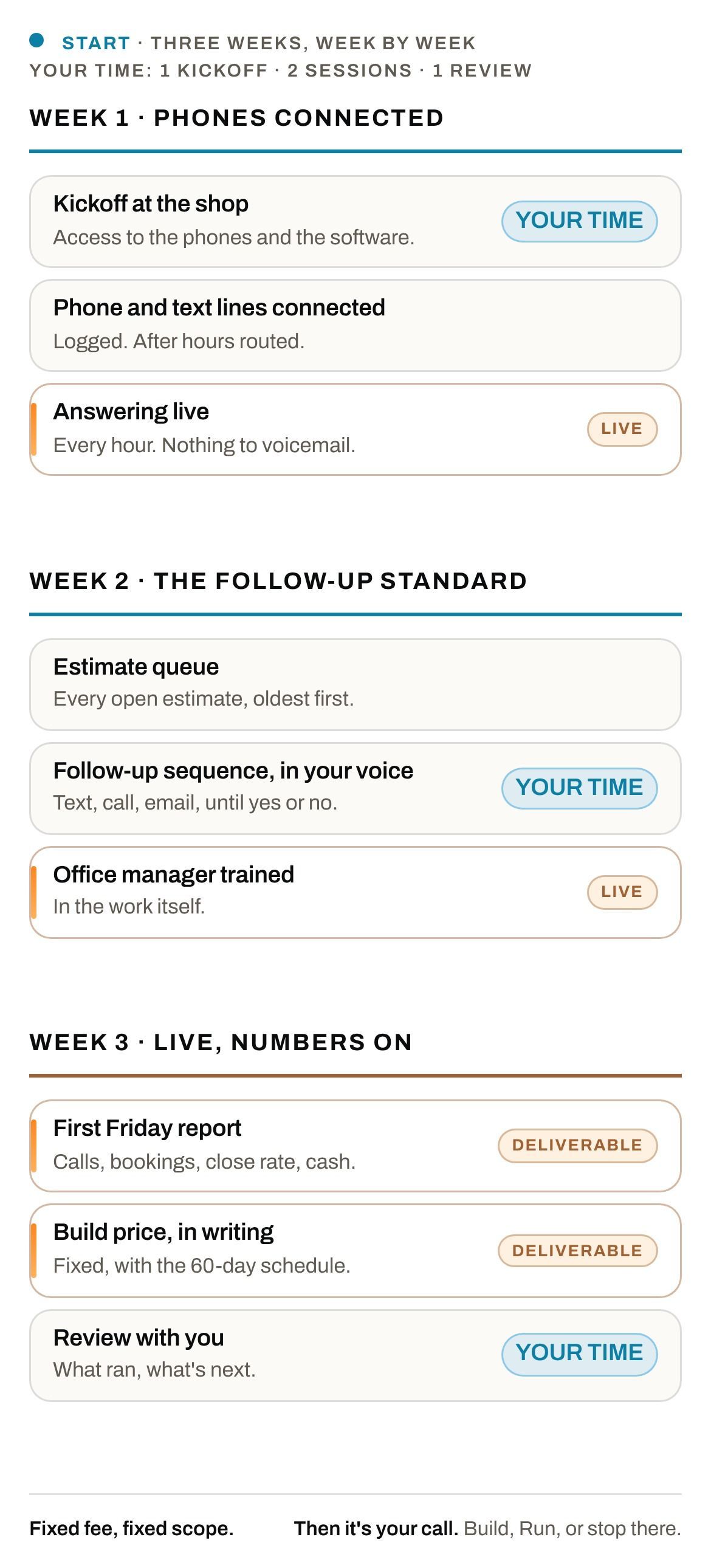
Clear prices
Clear prices, per company.
Every price is per company and fixed before the work starts. The Diagnostic is the only thing you buy without a plan in hand; the Rescue is priced from it. Three or more companies get a portfolio rate, in writing after the first Diagnostic.
The Diagnostic, at a glance
$9,500 · PER COMPANY · TWO WEEKS
Two weeks inside one company. Systems, people, risks, and the one workflow worth fixing first. The Rescue scope and price in writing. Run it on a target before close and it's Ops Diligence.
The Diagnostic · two weeks, day by day
The portco's time: one kickoff · four interviews · one readout. Yours: two hours.
Days 1 to 3
Kickoff and four interviews
Owner-operator, GM, controller, office lead. Your goal for the company, in one line.
The portco's time
Days 4 to 5
Systems and the site
Up to five systems or AI tools, as they actually run. The priority workflow, walked end to end.
We look
Days 6 to 9
The deliverables
Systems map. Risk and ownership view, with what leaves with the owner. Workflow blueprint. Engineered action plan.
Deliverables
Day 10
The readout
Findings reviewed with the operating partner and the CEO. Rescue scope and price, in writing.
Your time
Fixed fee, fixed scope. The clock starts at confirmed kickoff, access, and interviews.
Then it's your call. Rescue, on your own, or not at all. The plan is the portco's either way.
The Diagnostic
Per company · start here
Two weeks inside one company. The plan, the risks, and the Rescue price in writing.
$9,500
PER COMPANY · TWO WEEKS · PAID IN FULL
Included
◉ Systems map, as found
◉ Risk and ownership view, with key-person risk
◉ Priority workflow blueprint
◉ Engineered action plan, in order
◉ Readout with the operating partner and the CEO
◉ The Rescue scope and price, in writing
Not included: the fix itself (that is the Rescue), software subscriptions, which stay in the portco's name, and ongoing operations (that is Operate).
The Rescue
Most companies
The priority workflow, engineered into the software the company already runs.
From $35,000
PRICED FROM THE DIAGNOSTIC · FIXED · DAYS 15 TO 60 · IN FULL OR THREE PAYMENTS
INCLUDED
◉ Everything in the Diagnostic
◉ The priority workflow live, inside the portco's own systems
◉ Groundwork installed: one revenue record, ads and follow-up measured to closed revenue, the same in every company
◉ The integrations, one way the work moves, handoffs on their own
◉ Permissions, escalation rules, a named owner for every exception
◉ A record of every action, ready for diligence, which is what diligence asks for
◉ The team trained in the work itself
◉ Live by day 60, or we keep building
Operate
Ongoing
Keep the number honest and build the next workflow, month after month.
$5,000 or $10,000 a month
PER COMPANY · THREE-MONTH MINIMUM
INCLUDED
◉ Everything in the Rescue, kept running
◉ One review a month with the CEO and the operating partner
◉ Fixes, drift, and one measured improvement a month
◉ The same five numbers reported in every company you own
◉ Your Groundwork plan for the company, included
◉ The next workflow each quarter, at the $10,000 level
◉ Access, rules, and vendors reviewed each quarter
Three or more companies get a portfolio rate, in writing after the first Diagnostic. Software subscriptions and usage run on the portco's own accounts and are never marked up. Run the Diagnostic on a target before close and it's Ops Diligence: same price, same two weeks. Groundwork on its own is $299, $699, or $1,499 a month per company.
Who builds it
Engineering on the portco's side of the table. By founders who took their own company from zero to market.
GroundedPath AI is an engineering team based in Jacksonville Beach. Not a consultancy. Not a vendor. The people who took Start Left Security from zero to market, built SOPHIE inside a working practice, and run Groundwork, the revenue operating system we built, in our own companies every day. We know what a 100-day plan looks like from the inside and what diligence asks for, because we've answered it. One named team across every company you own. Trust is table stakes in a sale, so it's built in.
The portco's data stays the portco's
A named human owns every exception
A record of every action
One accountable team across the portfolio
Start
◉ Live in 60 days, or we keep building
Run
◉ The next piece each quarter, at the $10,000 level
The questions a deal team asks on the first call. Answered the way we'd put them in writing.
What does it cost per company?
The Diagnostic is $9,500 per company and takes two weeks. The Rescue is priced from the Diagnostic and fixed before the work starts, from $35,000. Operate is $5,000 or $10,000 a month per company with a three-month minimum. The prices are published here and they don't change on the call.
Is there a portfolio rate?
Yes, for three or more companies. We put it in writing after the first Diagnostic, once we've seen how your companies actually run, not before. One company first is the rule. It's how the price stays fixed.
How fast is it live?
The Diagnostic takes two weeks. The Rescue is live by day 60, or we keep building until it is. Inside a 100-day plan, that leaves 40 days of measured operation before the day-100 read. Company two is faster than company one.
What do you need from the portco?
Two weeks of access to its systems, four interviews (the CEO or owner-operator, the GM, the controller, the office lead), one site day, and a named person who owns exceptions after launch. From the operating partner: the goal for the company in one line at kickoff, and the readout. About two hours.
How does this show up in diligence?
As a record. Every system mapped, every workflow written down and running, every exception with a named owner, every AI action logged. A buyer's diligence team gets a walk-through instead of an excavation, and the key-person risk is on paper as resolved, not promised.
Who owns the systems and the data at exit?
The portco. Software subscriptions and usage run on its own accounts, and the data is its data. What we build is engineered into the software it already runs, so it transfers with the company. If we ever part ways, the record stays with the company.
Do you work with competing sponsors or competing companies?
We don't share one company's data, numbers, or playbook with another, inside your portfolio or outside it. If a company we're asked to diagnose competes head to head, in the same market, with one we already operate, we tell you before the engagement starts and let you decide.
Where do you work?
We're based in Jacksonville Beach, Florida. Southeast portfolio companies get us on site for the kickoff and the site day. Everywhere else gets a named team on video, with one site visit inside each Diagnostic. Three or more companies in one region, and the travel is planned into the portfolio rate.
Can you run this on a target before we close?
Yes. That's Ops Diligence: the same Diagnostic, run on the target in two weeks, same price. You get what runs on systems, what runs on the owner, and what the first 100 days would cost to fix, as a number for the model. If the seller won't give access, that's a finding too.
What about a company we're preparing to sell?
That's Exit Incubation. For a portfolio company two to seven years from exit, or an owner you're courting, the system goes in while they still own it, so the EBITDA is up and the key-person risk is down before a buyer opens the books. Advisors can refer a client through the same form.
What is Groundwork, and why is it in every company?
Groundwork is the revenue operating system we built and run in our own companies. In a portco it's the one customer record: ads, campaigns, follow-up, and retention run through it and measured to closed revenue, the same way in every company you own. It replaces the four to six revenue tools the last owner bought, and once it's set up it runs on its own inside the rules you set, so the portco doesn't need a marketing hire to run it.
Application received. The right questions are now on the table. We'll reply within one business day with the Diagnostic scope. If it's accepted, you get the systems map, the risk and ownership view, the priority workflow blueprint, and the engineered action plan.
Add your name, practice or group, work email, and group size so we can scope the Diagnostic.
TALK TO US ABOUT A DEAL
Tell us the company and the moment. We’ll tell you what we’d do first.
Thirty minutes with the operating partner or the deal lead. You tell us which company, where it is in the deal (before close, in the 100-day plan, or on the way to a sale), and what the plan says it should do. We tell you what we’d diagnose first, how long it takes, and what it costs. No deck. If we’re not the right fit, we say so.
No obligation. A person reads every form and replies within one business day. Under NDA when you need it; send yours or use ours.
The mandate is in the plan. Let’s put the execution in the portco.
Get my Ops Review
We will get back to you as soon as possible.
Please try again later.
A person replies within one business day. Your information is never sold or shared.