AI engineering for healthcare practices and groups. Not an IT firm. Not chatbots.

Stop bolting AI onto your practice. We build it & let you get back to patients.
Stop bolting AI onto the practice. We're engineers. We build AI into the software you already run, set one way the work moves, automate the handoffs, put a human name on every exception, and keep building. You go back to patients.
Practice-side engineering. The connection and rules between software and people.
AI-native engineering, shipped to production
The brand, the marketing and the system that sells it
Leads, follow-up and renewals handled, with a person approving what matters
Numbers you can see every month
The work your team repeats, done by the system
Proof the work got done, not a promise




Why it breaks
You're a doctor. Not an AI department.
Every practice owner we meet is doing the same thing after hours: trying AI tools, testing chatbots, sitting through webinars. Months in, the practice runs the way it always did. Not because you're doing it wrong. Because a stack of tools is not an operating system. The gap is between the tool, the location, and the person who owns the outcome.
WHAT BREAKS
More tools. No one owns them.
The stack grows every quarter. The accountability for what it does shrinks every quarter. When something fails, the answer is "the AI did it."
A tool without an owner is a liability with a login.
WHAT BREAKS
Every location improvises.
The same work becomes a different process in every office. Central can't see it. Local can't fix it. The manager chases it by text.
Seven locations, seven ways to lose the same patient.
WHAT BREAKS
The doctor becomes the integrator.
Clinical leadership inherits a systems job it should never own: the logins, the exports, the vendor calls, the 7 pm "why didn't this sync."
Operating rule 001: the doctor is not the systems integrator.
The owner and the doctor, looking at the same map.
A practice doesn't need more AI. It needs the system that makes AI work together.
An operating layer connects the software you already run, sets one way the work moves, automates the handoffs, and puts a human name on every exception. Then somebody keeps building it. That's what we do. You go back to patients.
What we actually do
We make separate systems work like one practice.
Most groups don't need more software. They have plenty. What fails is everything between the software: the connections, the rules, the handoffs, the ownership. That's engineering work, and it's the work we do. Not IT. We don't manage your network or your laptops. We build the layer that runs the work.
01
Connect the systems
We write the code that makes your practice software, phones, forms, billing, and the AI tools you already bought pass context to each other, instead of living in separate tabs.
02
Standardize workflows
One reliable way the work moves across every location, while the decisions that must stay local stay local.
03
Automate handoffs
Clinical to admin. Central to local. Inquiry to appointment. The next owner sees the work without anyone chasing it.
04
Govern exceptions
Permissions, escalation rules, and a named human for everything the system can't resolve. A record of every action, so you can see what the AI did.
05
Keep building
Measured every month, fixed when it drifts, and the next workflow built when you're ready. Software nobody improves is software that quietly stops.
Not an IT firm. AI engineers, building the way your practice runs.
An MSP keeps the computers on. A chatbot vendor sells you a widget. We're the team that built and sold its own software products, and we build the operating layer your practice runs on, inside the systems you already pay for. Then we keep building.
The connection and rules between AI, software and people.
Practice-side engineering · GroundedPractice AI
First outcome
The first workflow we fix is usually the front office.
It's where the most money leaks and where the most tools get bolted on. Lead response, scheduling, handoffs, exceptions: four steps, one visible path, a human owner at the end of it.
01
Lead response
Every inquiry, from every channel, enters one visible path. Nothing waits in a local inbox or a voicemail nobody checks.
02
Scheduling
Requests stop disappearing. The next open slot, the right room, the right provider, booked and confirmed, with the standard attached.
03
Handoffs
Central and local teams see the next owner. Clinical to admin and back, without the sticky note.
04
Exceptions
Unresolved work reaches a named human, on time, with the context. Not a queue. A person.

Category correction
Not an AI receptionist.
An engineered, accountable front-office operating layer.
Technology does not own the handoff. People do. The system just makes sure the handoff happens.
—Replaces the pile: CRM, prospecting, the intent data on who's shopping, follow-up, customer success, and partner/affiliate distribution
One of the pieces
When it fits, SOPHIE is the operating layer we install.
A practice that runs on systems, not on you.
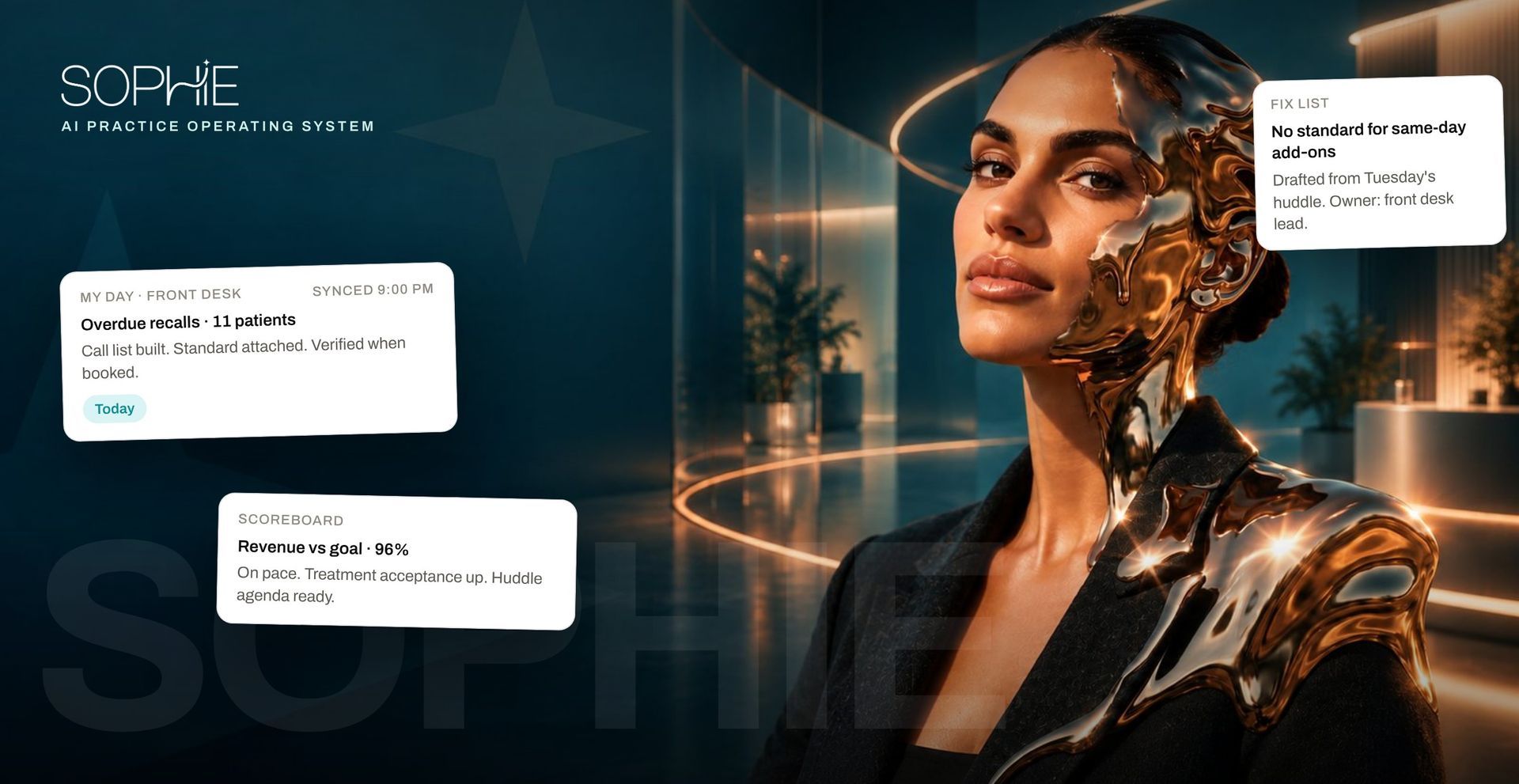
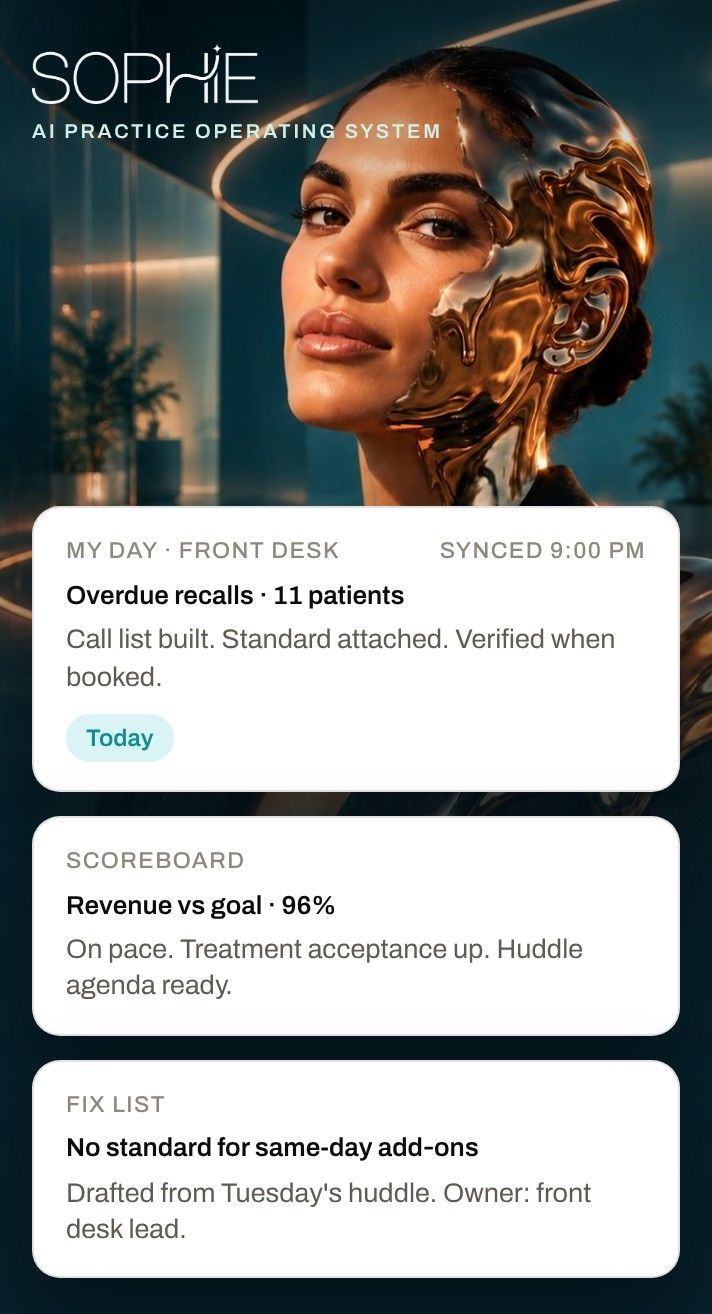
SOPHIE is the AI practice operating system we built inside a working practice, from the first line of code. It turns what happens in your practice software into assigned work, written standards, and verified results. You don't have to buy it. When it fits your group, it's one of the pieces we install and run with you. When it doesn't, we build the same layer on the software you already run. SOPHIE runs the practice. Groundwork, the revenue system we built, runs its growth: campaigns, follow-up, recall, reviews, one patient record. We connect both to the practice systems you already run.
—My Day, Scoreboard, Patient Journey, Fix List, Power Meets
—Ask Sophie anything about your practice, in plain words
—Connects to the practice software you already run
—Running on systems by day 30
On its own, $5,995. Included in a Rescue when it fits.
Who this is for
Mature practices and multi-location healthcare groups.

Owner, doctor, operations lead. One table, one map.
Not a fit
—
Hospitals and health systems with no budget.
—
Practices that haven't opened yet.
—
Anyone shopping for a chatbot.
Built for clinician-led, location-based groups: the ones with plenty of software, a few AI pilots, and nobody who owns the space between them. Not hospitals. Not health systems.
Practice types
Dental, orthodontics, and oral surgery
Optometry and ophthalmology
Dermatology and plastic surgery
Medspas, aesthetics, and wellness clinics
Primary care, pediatrics, and urgent care
Women's health and fertility
Behavioral health and psychiatry
ABA, speech, and pediatric therapy
Physical therapy, chiropractic, and rehab
Orthopedics, podiatry, and pain management
ENT, allergy, and hearing care
GI, cardiology, and other specialty groups
Groups and service organizations
DSOs and OSOs
MSOs and practice management companies
PE-backed platforms and roll-ups
Independent multi-location groups
Franchise clinic brands
Physician- and clinician-owned partnerships
Call us when
—
Your tools can't pass context to one another.
—
The same workflow runs differently at every location.
—
Managers chase unresolved work by hand.
—
AI pilots stall because the data and the workflow aren't ready.
—
Nobody clearly owns the integration when it fails.
How you buy it
Diagnose it. Rescue it. Keep building.
One accountable path. We find out what the practice can actually run, engineer the fix, and stay after launch. Four steps, and the doctor isn't the integrator at any of them.
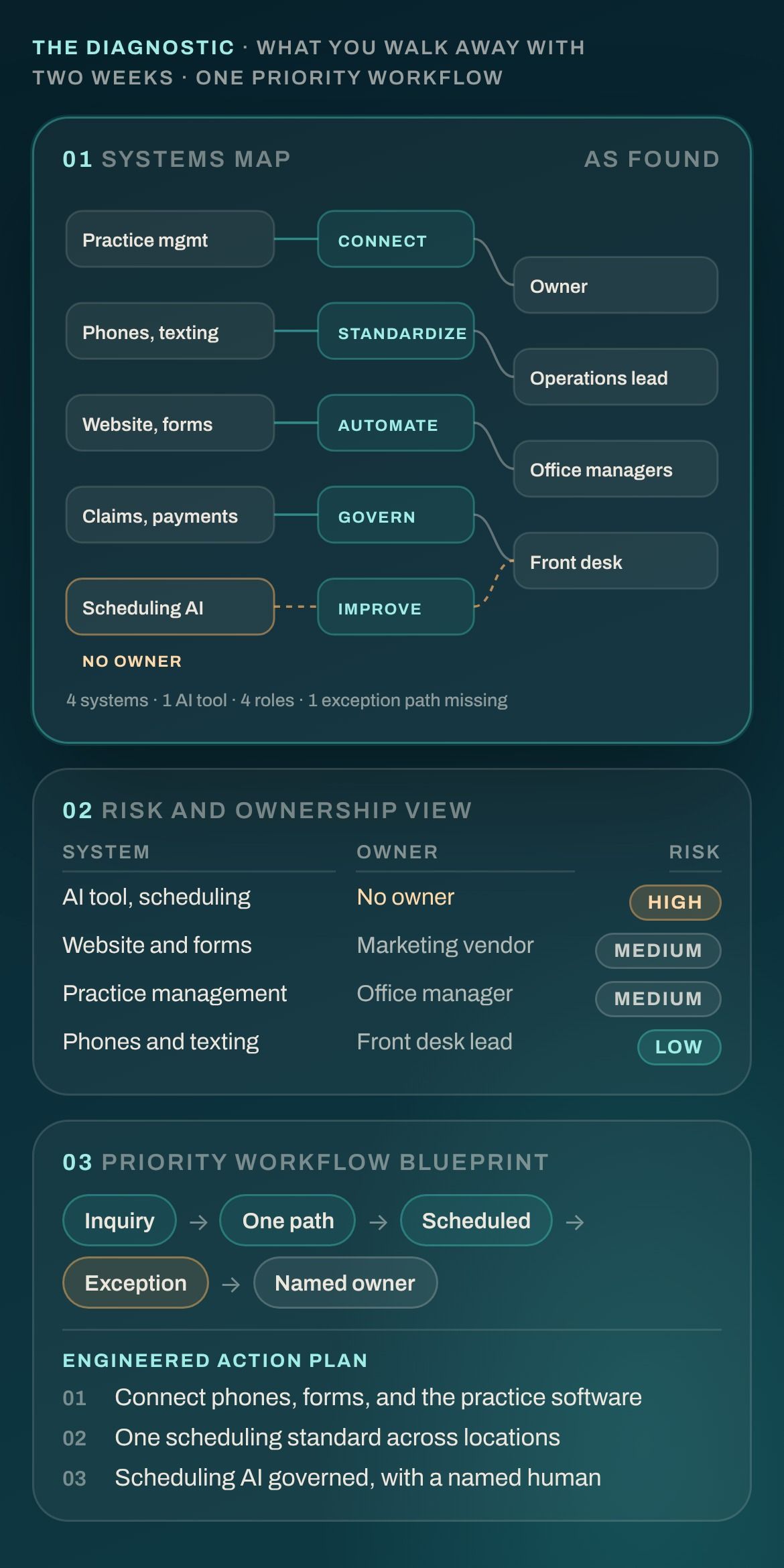
Diagnose The Diagnostic · $9,500 per company
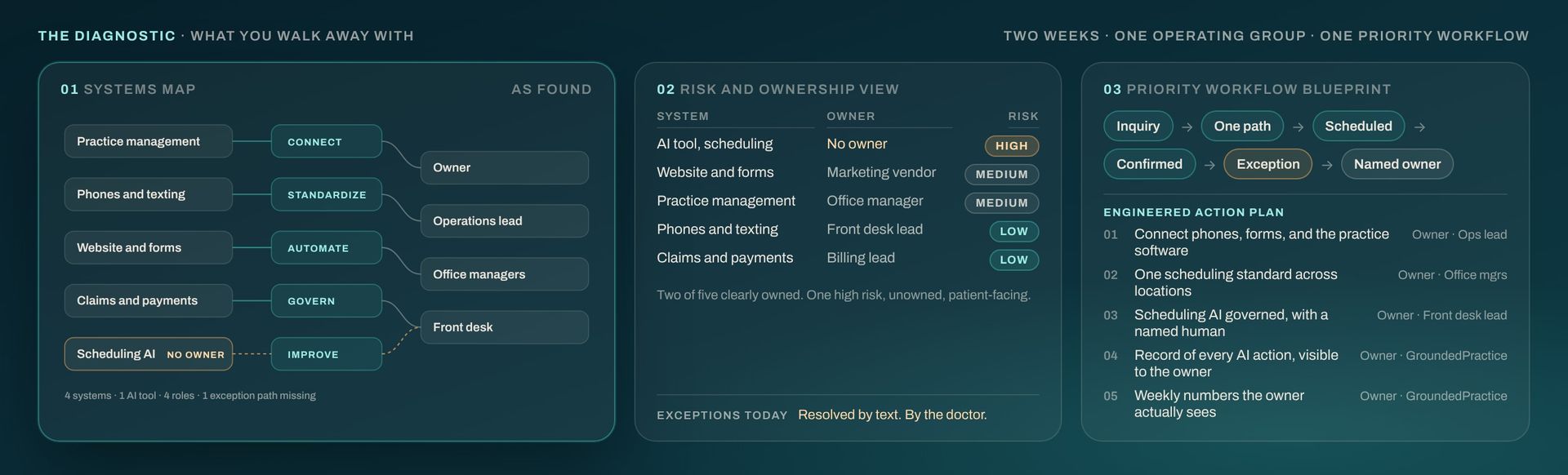
Two weeks inside one portco. The systems, the people, the risks, and the one workflow worth fixing first. Up to five systems or AI tools, four interviews, one priority workflow. The Rescue scope and price in writing. Run it on a target before close and it's your Ops Diligence.
- Systems map, as found
- Risk and ownership view, key-person risk included
- Priority workflow blueprint, with the Rescue scope and price
Rescue Priced from the Diagnostic · fixed
The fix, engineered into the software the company already runs. The integrations, one way the work moves, handoffs that happen on their own. Permissions, escalation rules, and a named owner for every exception. The team trained in the work itself.
- The priority workflow live, inside the portco's own systems
- A named owner for every exception, a record of every action
- Software subscriptions and data stay in the portco's name
Operate Monthly · three-month minimum
We stay. The five numbers reviewed with the portco CEO and the operating partner every month, drift fixed, and the next workflow built as the company grows or adds locations. The report looks the same in every company you own.
- One review a month with the CEO and the operating partner
- One measured improvement a month
- The next workflow, when you're ready
Repeat Portfolio rate · in writing after the first Diagnostic
The second company is faster than the first: reusable components, the same report format, the same named team. Three or more companies get a portfolio rate. The deal team goes back to deals.
- Portfolio rate for three or more companies
- The same five numbers in every company
- One accountable team across the portfolio
Start
◉ Live in 60 days, or we keep building
Run
◉ The next piece each quarter, at the $10,000 level
The Diagnostic, and what comes after
Before you buy another AI tool, find out what your practice can actually run.
One fixed-scope engagement. One priority workflow. A factual plan for what to repair, connect, govern, or retire. Implementation starts only under a separate Rescue scope, priced from what the Diagnostic finds.
The Diagnostic, at a glance
$9,500 · TWO WEEKS · FOUR DELIVERABLES
Fixed fee, paid in full before kickoff. Two weeks from confirmed kickoff, access, and interviews. You walk away with the systems map, the risk and ownership view, the workflow blueprint, and the engineered action plan.
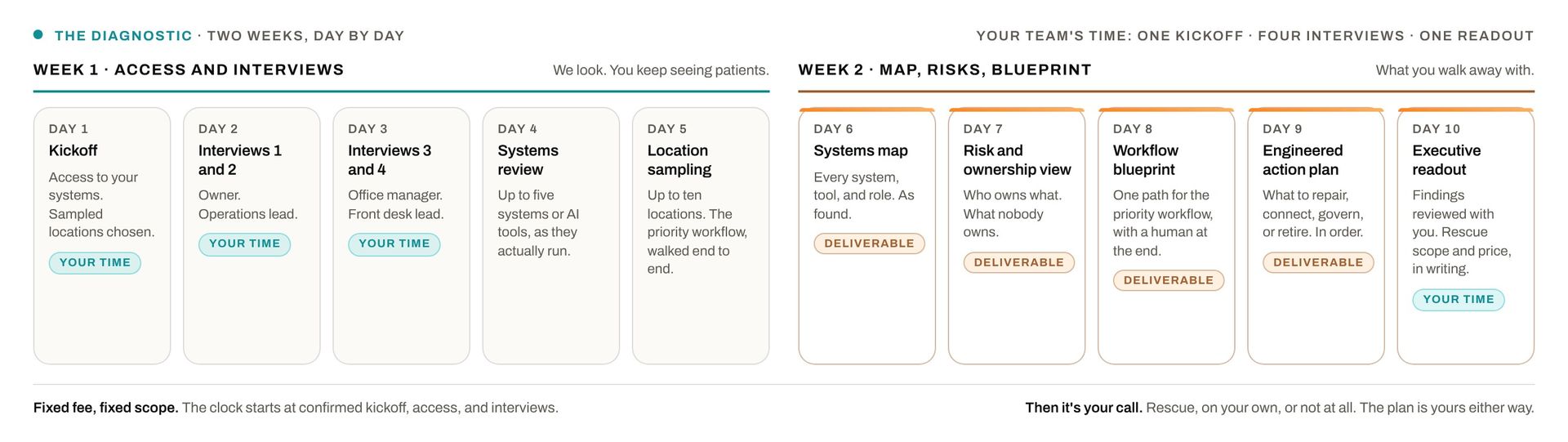
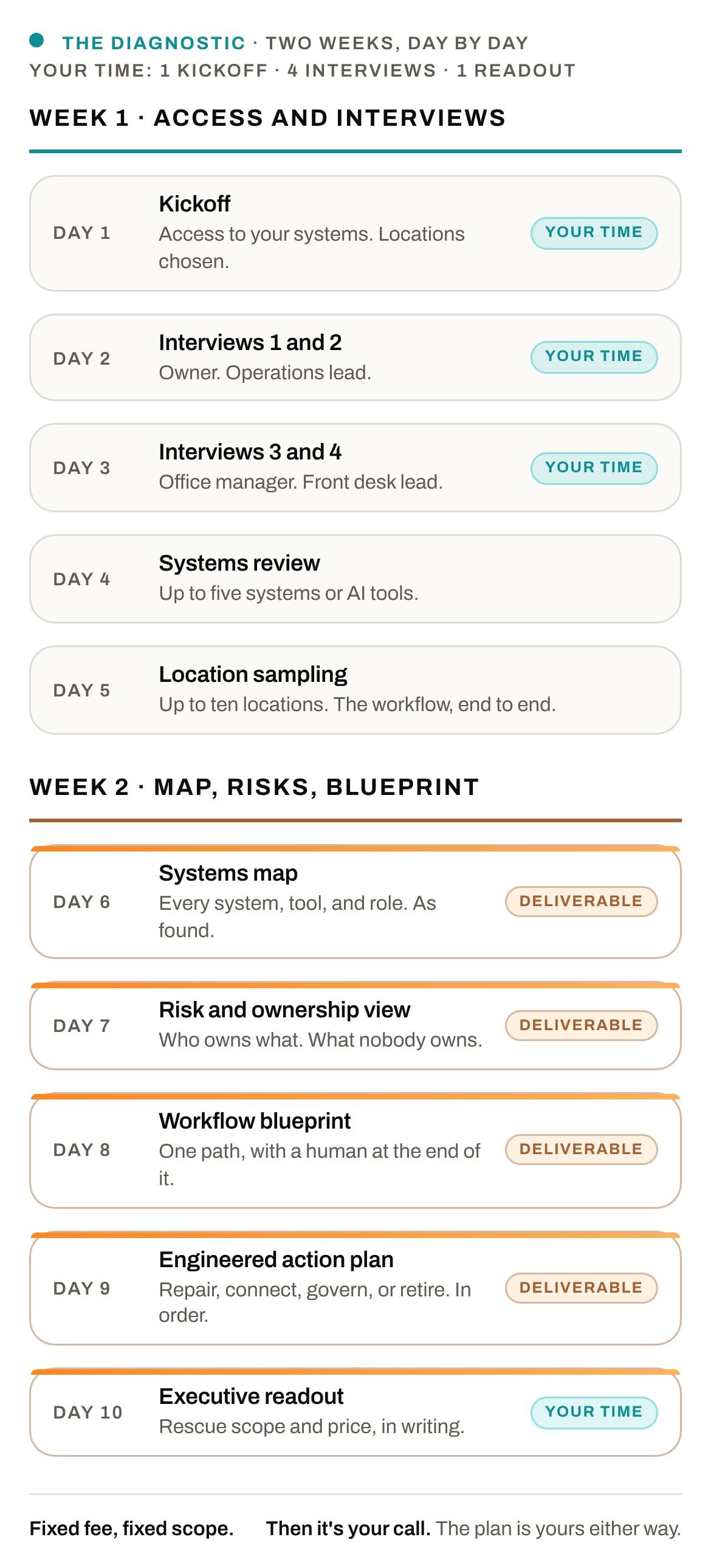
The Diagnostic
PAID ENTRY POINT
Map the systems, workflows, risks, ownership gaps, and the first workflow to control.
$9,500
TWO WEEKS · PAID IN FULL
Included, scope locked
◉ One operating group
◉ Up to 10 sampled locations
◉ Up to 5 systems or AI tools
◉ Up to 4 stakeholder interviews
◉ One priority workflow
◉ One executive findings review
Not included: implementation, custom integrations or software, data migration, vendor and licensing fees, legal or compliance certification, and ongoing operations. Those are the Rescue and Operate and Improve.
The Rescue
FLAGSHIP
Engineer the fix: the integrations, the one way the work moves, the governance, the owners.
Priced from the Diagnostic
SCOPE, TIMELINE, AND PRICE IN WRITING BEFORE YOU COMMIT
INCLUDED
◉ Everything the Diagnostic found, fixed in priority order
◉ Your systems connected, one record of the work
◉ The priority workflow live across every location
◉ Permissions, escalation, and a named owner for every exception
◉ SOPHIE, the AI practice operating system, when it fits ($5,995 on its own)
◉ Groundwork for new-patient campaigns, recall, and reviews, connected to your practice systems ($299, $699, or $1,499 a month on its own)
◉ Your team trained in the work itself
Operate and Improve
ONGOING
We stay, and keep building, as the practice changes. Separate operating scope.
Monthly
SCOPED WITH THE RESCUE · THREE-MONTH MINIMUM
INCLUDED
◉ The numbers reviewed with you every month
◉ Drift fixed; rules, access, and vendors reviewed each quarter
◉ One measured improvement a month
◉ Your SOPHIE plan, included, when it's installed
◉ The next workflow or location, when you're ready
Groups and multiple locations are priced per location in the Rescue. Model, phone, and messaging usage runs on your own accounts and is never marked up.
Who builds it
Practice-side engineering. By people who've built companies, and practices.
GroundedPractice is the healthcare program from GroundedPath AI, an engineering team, not an IT firm: the people who took Start Left Security from zero to market, and built SOPHIE inside working practices. The people who run it with you have grown a practice from one location to thirteen. Trust is table stakes here, so it's built in.
Your patient data stays yours
It trains no one's model
A named human owns every exception
A record of every action
Application received. The right questions are now on the table. We'll reply within one business day with the Diagnostic scope. If it's accepted, you get the systems map, the risk and ownership view, the priority workflow blueprint, and the engineered action plan.
Add your name, practice or group, work email, and group size so we can scope the Diagnostic.
Apply for the Diagnostic
Name the workflow. We'll tell you what your practice can actually run.
This is an application for the published $9,500 fixed-scope engagement, not a generic request for AI help. We read every one and reply within one business day. If the Diagnostic isn't the right first step for your group, we'll say so.
Accepted engagements are $9,500 USD, paid in full before kickoff. The two-week clock starts after payment, access, and interviews are confirmed. Implementation is a separate scope.
AI has to work in the practice, not just in the demo.
Apply Now
We will get back to you as soon as possible.
Please try again later.
We reply within one business day. We never share what you tell us.